Many science fair projects solve a small problem and stop there, but Arya Satheesh’s science fair project didn’t. The 18-year-old from Letterkenny built a smart water monitor for a school STEM competition, and hit a dead end. That dead end became Eco Purge, a biodegradable plastic that helped her become the European Regional Winner of the Earth Prize 2026, which Smithsonian magazine and the prize’s own organisers both describe as the largest environmental competition in the world for young people, drawing over 6,000 applications this year.
There’s a genuinely useful lesson in how she got there, and it’s worth more to students and teachers than the headline ‘teenager invents plastic-eating plastic’ ever will be.
From a Limited First Project to a Regional Win
Satheesh’s first project, entered into SciFest, Ireland’s largest second-level STEM fair programme, wasn’t about plastic at all. It was a water monitor designed to detect contaminants in drinking water. It worked, picking up microplastics in real water samples. But that raised a new problem: detecting microplastics isn’t the same as removing them.
That gap became the question behind Eco Purge. A science fair project doesn’t have to solve a problem outright to be worth something. Sometimes its real value is the better question it leaves you with.
Getting from question to prototype wasn’t smooth. The enzyme Satheesh needed wasn’t just hard to find, it was expensive: three milligrams cost around $2,500, well beyond what a student could reasonably buy herself. After being turned down more than once, she found Kevin O’Connor, director of BiOrbic, Ireland’s national bioeconomy research centre, who didn’t have the enzyme on hand either but offered to source it from suppliers in Denmark and Germany instead. She went on to work with researchers at Atlantic Technological University Letterkenny and University College Dublin to develop the prototype. None of that happened because the project arrived neatly resourced. It happened because she kept asking.
The Real Science: How Enzymes Are Turning Plastic Against Itself
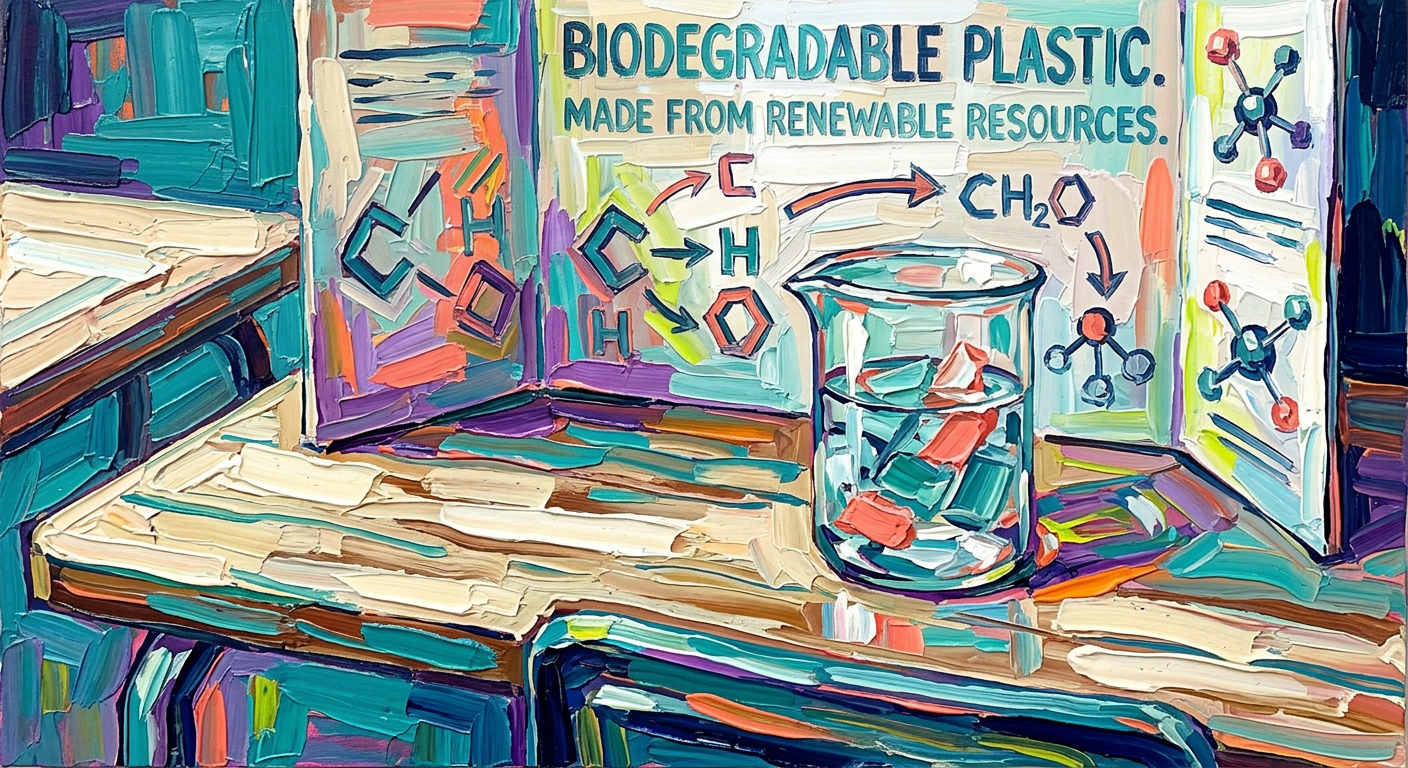
Eco Purge is a plant-based bioplastic that carries enzymes inside its structure. Once discarded, it takes up to two weeks to biodegrade, and as it does, it releases those enzymes into the surrounding soil or water, where they get to work breaking down other PET-derived microplastics nearby, the kind of plastic commonly found in packaging and textiles.
This isn’t invented chemistry. Scientists identified PETase, a bacterial enzyme capable of breaking down PET plastic, in 2016, building on research into PET-degrading enzymes dating back to 2005. What’s novel in Eco Purge isn’t the enzyme chemistry itself, it’s what the plastic does on two separate fronts at once: being biodegradable means it doesn’t linger in the environment the way conventional plastic does, and its embedded enzymes go a step further by actively breaking down microplastics that are already there.
She tested the idea across three environments, soil, salt water and fresh water, over six weeks. By the end of the trial, both the Eco Purge and the microplastic sitting alongside it had visibly degraded in every case.
What Made This Science Fair Project Stand Out
Charles Rolsky, senior research scientist at the Shaw Institute, put his finger on the actual innovation. Most solutions to plastic pollution focus on reducing how much new waste enters the environment. Eco Purge does that too, but what Rolsky pointed to as the real distinction is that it also targets microplastics already out there, a shift he described as moving from passive containment to an active solution.
That’s a transferable lesson for anyone judging or planning a science fair project: it’s not enough to build something that works. The strongest projects can say precisely what gap they’re closing that existing approaches don’t.
The Honest Caveat: This Isn’t a Silver Bullet Yet
Rolsky was equally clear about the limits, and they come in two distinct forms. The first is chemical: enzymes work on a lock-and-key basis, so one tailored to Eco Purge’s PET-derived target won’t affect the different plastic types mixed into most real-world waste. In open environments like oceans, he noted, released enzymes would also probably dilute into the surrounding water, limiting their contact time with microplastics, so realistic deployment is more likely confined to controlled settings like compost facilities.
The second limit is industrial. Standard plastic processing runs on high heat, which Rolsky said typically destroys the delicate biological enzymes Eco Purge depends on, making it hard to scale production to a commercial level without struggling to compete with the low margins of traditional packaging. That’s not a scaling detail to iron out later, it’s a real unsolved problem sitting between the prototype and any large-scale use.
Satheesh herself has described this as a starting point, not a finished solution, and plans to spend the next several years refining the material toward applications like packaging and garbage bags. That honesty matters. Overselling results is one of the more common ways a strong project gets undermined at judging, and being upfront about what’s still unsolved is part of what made this one credible.
What This Means If You’re Planning Your Own Science Fair Project
For more student-led invention stories in this vein, see our Young Scientists section.
Treat a limitation as your next question, not a dead end. Her water monitor worked. It also revealed a problem it couldn’t solve. That gap became the actual project.
Ask people you haven’t got an obvious reason to expect help from. Rejection didn’t stop the search for enzyme suppliers, it just meant finding the next person to ask.
Say exactly what problem you’re solving, and be equally clear about what you haven’t solved yet. The strongest case for Eco Purge wasn’t the working prototype alone, it was a precise account of the gap it closes and an honest account of its limits.
So the next time a project you’re working on hits a wall it can’t get past, that’s not necessarily the end of it. It might be the point where the more interesting project actually starts.
Leave a Reply